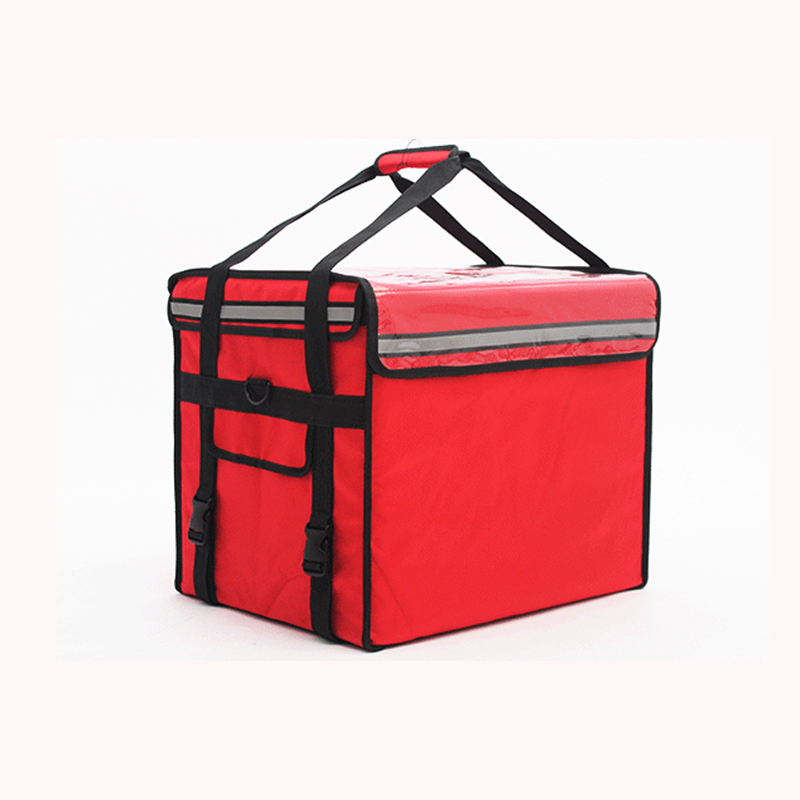
Delivery-oriented format
The soft-sided carrier is intended for lunch, takeaway and local food-delivery workflows.

Flexible Thermal Packaging · Insulated Bags
A soft-sided insulated bag for lunch and food-delivery use. The selected model’s dimensions, capacity, outer fabric, insulation, inner liner and closure must be confirmed before ordering. A packout is the complete arrangement of the product load, coolant where required, insulated bag and closure; its thermal duration depends on the complete configuration and delivery route.
Product Overview
This insulated lunch and food-delivery bag can be configured with an outer layer, insulation layer, inner liner, closure and carrying system for the intended workflow. Begin selection with the product load, required usable capacity, cleaning method and delivery conditions, then confirm the complete model specification before ordering.
The soft-sided carrier is intended for lunch, takeaway and local food-delivery workflows.
A flexible construction can reduce storage volume when the bag is empty, subject to the selected reinforcement.
Outer fabric, insulation and inner liner can be specified for the intended handling and cleaning procedure.
Gel packs or rigid coolant bricks can be evaluated after the load, required separation and delivery route are defined.
Product Parameters
Product Specifications
Define the required load and delivery workflow first, then record the selected dimensions, materials, closure and accessories on the product specification.
| Specification | Reference data | What to confirm |
|---|---|---|
| Product format | Insulated lunch and food-delivery bag | Confirm the model code and intended product load. |
| External dimensions | To be specified for the selected model | Provide maximum delivery-space and handling constraints. |
| Usable internal capacity | To be specified for the selected model | Provide product dimensions, quantity, coolant and required clearances. |
| Layer construction | Outer fabric, insulation and inner liner | Confirm materials, thicknesses, lamination, cleaning method and product-contact requirement. |
| Closure and carrying system | Project-specific | Confirm zipper or other closure, handles, webbing and reinforcement. |
| Thermal duration | Established by complete-packout testing | Provide the product-temperature range, delivery time, coolant and route exposure. |
Use & Packout
Because dimensions and materials vary by configuration, use the selected drawing and order specification for packing. Any coolant should be brought to its required starting state before loading.
Verify model code, external and internal dimensions, capacity, outer fabric, insulation, liner, closure and handles.
Check the outer shell, handles, seams, closure and inner liner for damage, contamination or open stitching.
Bring the food load and any gel packs or rigid coolant bricks to the starting conditions defined for the delivery procedure.
Arrange the product and coolant with the required separation and keep the closure free of obstruction.
Close the bag fully, minimize opening during delivery, and follow the cleaning and inspection procedure for the selected materials.
Complete transport configuration
Confirm the minimum and maximum product load, any coolant or other thermal-control component used, starting conditions, closure and opening frequency, route ambient-temperature profile and transit duration in a defined complete-configuration test or qualification protocol.
These references explain industry qualification and transport practices. They do not certify this product or replace testing of your complete packout. Using an ISTA 7E profile alone does not constitute ISTA certification.
From single-meal lunch totes to 30–40 L delivery bags sized for multi-order runs, with dimensions set against your packaging footprint.
600D Oxford fabric is the standard face; denier, coating and color can be adjusted for heavier duty cycles or a lighter carry weight.
EPE foam in 5 mm or 8 mm builds, letting you trade weight against temperature hold time for your typical delivery radius.
PEVA lining is food-contact friendly, leak-resistant and easy to wipe down — a practical choice for repeated daily use.
Zip, flap or top-load openings, plus handles, shoulder straps and internal dividers matched to your food containers.
Custom fabric colors and printed logos across the body or front panel for a consistent fleet look.
Project Configuration
Share the product dimensions, item count, required product-temperature range, route duration and ambient conditions, coolant plan, care requirements, closure preference and expected order quantity for configuration review.
Product Documents
Available documents vary by model, material construction and project requirements. Ask us to confirm the files available for your quotation or sample.
Dimensions, capacity where applicable, layer construction, closure details and carton-packing data for the selected model.
Available layer, liner, insulation, closure and applicable material-compliance information for the selected configuration.
Product dimensions, artwork area and carton data for the selected model.
Frequently Asked Questions
Use these answers for initial selection. For ordering and packout setup, follow the specifications and instructions confirmed for your model.
Provide the product dimensions, number of items, coolant quantity, required clearances and maximum delivery-space constraints. Confirm usable internal capacity on the drawing.
The exact outer fabric, insulation and inner liner are selected by configuration. Request one complete material specification rather than applying a family option automatically.
No. Duration depends on the product load, coolant, construction, starting conditions, closure, opening frequency and route exposure. Validate the complete packout.
They can be reviewed as coolant components. Confirm their quantity, placement, conditioning and separation from the food load for the intended route.
Quote & Sample Request
Share the information below so our team can recommend a suitable product configuration.
Selected product
We will review a standard or custom configuration after receiving your project details.
Our response will cover the selected model, available documents and sample options.