
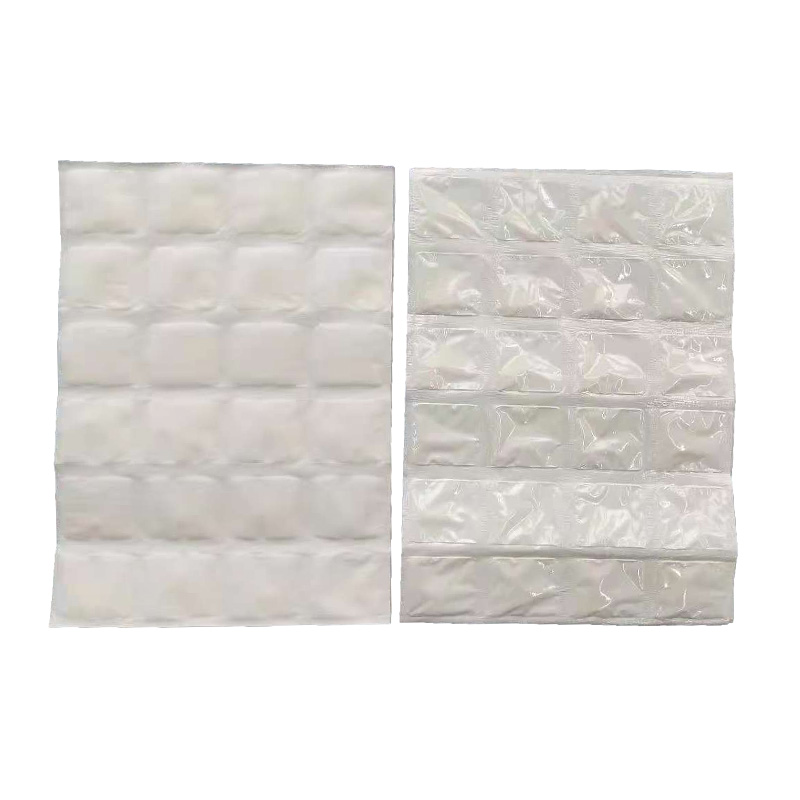
Wholesale dry ice pack for milk delivery for Distributed and Changing Routes
A wholesale dry ice pack for milk delivery is increasingly purchased for networks that do not look like one controlled cold room followed by one refrigerated truck. Orders may move through micro-fulfillment, centres de colis, cross-docks, export holds, route vehicles, casiers, and doorsteps. The sheet can be useful because it stores compactly before activation and conforms around payloads, but the program succeeds only when each channel's exposure and local operating capacity are understood.
For a packaging distributor, dairy wholesaler, route-service company, reseller, or procurement manager, this is both a packaging and a network-design decision. Durabilité, peak demand, travail, récupération du congélateur, continuité d'approvisionnement, and change control can be as decisive as laboratory cooling. Performance claims should stay tied to the packout and route rather than expanding as the product enters new channels.
Wholesale Channels Serving New Milk-Delivery Models
Hydration coolant sheets are attractive in distributed operations because they can move and store flat before activation. The operational burden is transferred to the packing site, which must supply clean water, controlled hydration, drainage, capacité du congélateur, supports, mise en scène, and trained labor. That trade can be favorable, but it is not free and it becomes more visible as order volume grows.
The same sheet can appear to fit several wholesale milk delivery channels while performing differently in each. A parcel sort network, a scheduled vehicle route, a pallet movement, and a doorstep handoff create different heat events and handling loads. The coolant should be considered a configurable component inside channel-specific packouts rather than a universal answer.
Terminology remains important when networks cross borders or transport modes. A hydrate sheet and solid carbon dioxide are not interchangeable even when both are sold with dry ice wording. Composition, conditionnement, étiquettes, documentation, ventilation, and carrier acceptance should be confirmed for the actual material and route.
Common product and route cases are shown below. The categories are a prompt for segmentation. Each operator should group only shipments that have compatible payload conditions, géométrie, exposition, manutention, et recevoir des décisions.
| Product or route case | Main exposure or failure | Réponse de conception utile | Assumption to avoid |
|---|---|---|---|
| Local dairy route | Repeated stops, ouvertures de portes, et traitement des retours | Sell with a route-assessment and tote guidance | Do not displace vehicle control without evidence |
| Doorstep milk service | Unattended dwell and variable collection time | Define an insulated kit and receiving instruction | Customer behavior is part of the exposure |
| Parcel milk shipment | Sort hubs, vibration, and high surface area | Offer a mapped packout rather than a loose sheet | Protect bottles from direct frozen contact |
| Institutional account | Plus grand volume, dock delay, et documentation | Provide lot records and a controlled pack specification | Service support may matter more than SKU breadth |
Channel segmentation prevents an easy commercial mistake: copying a successful packout into a new service because the outer carton looks similar. A different carrier, modèle de séjour, delivery promise, or receiver can change the risk even when the product and coolant are unchanged.
Inventaire, Marque privée, and Customer Education
Thermal exposure often accumulates at interfaces. Goods can wait between the packing bench and pickup, between vehicles, outside a controlled dock, in a customs examination area, or at the final delivery point. Responsibility and data may also change at each interface. Map the physical event and the information handover together.
For wholesale milk delivery, the overlooked events often include listing one wholesale sheet as suitable for all milk delivery, quoting component hold time without the tested packout, losing factory lot identity during repacking, giving customers vague soak-and-freeze instructions, and holding inventory through an undocumented material change. A route map should identify the expected duration, environmental control, opérateur, preuve, and recovery action at each node. The answer may be added thermal margin, a better closure, different coolant placement, a service-level change, or a receiving alert.
Do not treat a smooth chamber profile as a perfect copy of the network. It is a controlled representation used for development or qualification. Supplement it with route observations and temperature data where appropriate. Investigate delays and partial-load behavior, then decide whether the test profile or operating controls should change.
Demand Peaks Without Technical Shortcuts
Scaling a hydration sheet program moves constraints upstream. Dry inventory may be compact, yet activated inventory expands and becomes heavy. The site needs soak tanks or another controlled activation method, espace drainant, manipulation propre, grilles de congélateur, circulation de l'air, mise en scène, inspection, and separation between ready, rejeté, and returned material.
Model the peak hour rather than the average week. Count sheets per order, dispatch waves, freeze cycle, rack capacity, récupération du congélateur, temps de l'opérateur, stock de sécurité, espace de quarantaine, et retravailler. A promotional campaign can fail even with ample dry sheets if the freezer cannot restore the approved condition after repeated door openings.
Supply continuity should not authorize silent substitution. Define an approved bill of materials, qualified backup or second source if needed, and a review path for change. Capacity discussions should include peak carton packing, raw-material availability, production-lot size, inspection throughput, export preparation, and the lead time assumptions behind the promise.
Sustainability Across Factory, Grossiste, and Route
Sustainability needs a system boundary large enough to reveal trade-offs. A flat dry sheet may reduce inbound cube and cold storage before activation. It still uses material, eau, énergie de congélation, travail, emballage de protection, and an end-of-use route. The insulated carton, doublure, perte de charge utile, emergency reshipment, and return movement may dominate the result.
Wholesale consolidation may reduce small inbound shipments, but repacking waste, pallet damage, inventory loss, freezer energy at customer sites, and product outcomes remain relevant.
Flat dry sheets can improve warehouse density before activation.
Returnable systems should be offered only where a customer can control cleaning, inspection, retour, et perte.
Besoin d'une solution d'emballage pour cette application?
Par industrie
Parcourez les parcours de conditionnement par produit pharmaceutique, nourriture & applications logistiques de boissons et de chaîne du froid.
Explorer les solutionsPar plage de température
Trouver des configurations pour 2–8°C, 15–25°C et ≤−70°Expéditions C.
Afficher les plages de températureDemander un devis
Envoyez votre charge utile, itinéraire et temps d'attente — nous répondons avec une recommandation d'emballage dans 24 heures.
Avoid absolute green claims without a stated comparison and boundary. A practical internal metric can be cost, masse, énergie, or waste per successful shipment that meets the product acceptance rule. Review that metric by route family and season. It rewards right-sizing while keeping product protection visible.
Managing Supply Continuity and Substitution
The table turns network growth into questions for both operator and supplier. It prevents procurement from approving material while assuming that labor, gel, traçabilité, and channel fit will solve themselves later.
| Décision réseau | Question for the operator | What the supplier must support |
|---|---|---|
| Canal | Which wholesale milk delivery routes share the same exposure and handling? | Packout variants with clear boundaries rather than one universal claim |
| Peak volume | Can hydration, drainage, gel, mise en scène, and inspection keep pace? | Emballage en carton, continuité d'approvisionnement, and production-lot consistency |
| Remettre | Where can a shipment wait without active temperature control? | Geometry and test evidence that reflect the actual dwell pattern |
| Saison | What objective rule selects mild- and hot-weather configurations? | Stable specifications and samples for each controlled variant |
| Fin d'utilisation | Will packs be discarded, rétabli, inspecté, or reused? | Material information and a realistic handling pathway |
Supplier readiness is demonstrated through stable specifications, representative samples, lot identity, notification de changement, realistic capacity planning, and technical support that stays within evidence. Marketing flexibility without production discipline creates a fragile program.
Turning Route Feedback Into a Better Assortment
A platform approach can serve several routes without pretending that every route is identical. Keep common elements such as the sheet family, film, méthode d'activation, and inspection controls stable. Create controlled variants for sheet count, placement, tampon, isolation, or season only when data supports them.
Each variant needs a name, dessin, selection rule, qualification basis, instruction de travail, training path, and change-control status. Operators should not choose a version from memory or outdoor temperature alone. Utiliser l'itinéraire, produit, and dispatch criteria that are available at the decision point.
Review variants after launch. Compare temperature evidence, dommage, fuite, product acceptance, travail, capacité du congélateur, modèles de plaintes, and unusual dwell. Retire unnecessary configurations and investigate routes that repeatedly consume emergency margin. Controlled learning is more sustainable than permanent overpacking.
Commercial data should be organized by the same route families. Unit price alone hides activation labor, encombrement du congélateur, isolation supplémentaire, retours, and customer-service work. Track the cost of a successful accepted delivery, then investigate why one channel or season consumes more margin. This makes optimization a cross-functional decision rather than a packaging-only exercise.
Training must travel with the program. New sites, temporary peak staff, distributeurs, and third-party packers need the same product identity, méthode d'activation, freeze-status check, assembly drawing, variant selection rule, and deviation path. A short visual aid is useful, but it should point back to a controlled instruction and revision. Local improvisation can erase the value of centralized qualification.
Governance should define who owns route data, who can approve a packout change, who reviews supplier notices, and who decides product disposition after an exception. Without those owners, weak signals remain scattered among procurement, opérations, qualité, service client, et les transporteurs. A regular review can combine them before a pattern becomes a larger failure.
The result is a program that can adapt without losing its evidence. New routes begin with a comparison to an existing qualified family, followed by a documented risk assessment and the testing required for the difference. The organization keeps common components where they genuinely fit, while avoiding the false economy of forcing every shipment into one configuration.
Customer communication is part of that control. Quotes, catalogues, étiquettes, and training should describe what the component is, how it is activated, which released packouts it supports, and what the user must verify. Avoid converting a successful route result into a universal duration. Des limites claires réduisent les abus, make complaint investigation faster, and give distributors or fulfillment partners a consistent message as the network expands.
Foire aux questions
What is different about wholesale buying versus a direct factory order?
A wholesaler must manage inventory, customer fit, traçabilité des lots, instructions, plaintes, and claims across several accounts. The product specification therefore needs both factory controls and a clear customer-support boundary.
Can a wholesaler publish one hold time?
Only when the statement is tied to a defined and supported packout, charge utile, méthode de conditionnement, profil ambiant, et critères d'acceptation. A component duration should not be presented as universal performance for every milk route.
What information should sales staff collect from a dairy customer?
Collect milk type and required condition, bottle or pouch format, charge utile, case or tote dimensions, durée de l'itinéraire, s'arrête, contrôle du véhicule, exposition ambiante, isolation, dispatch condition, synchronisation du récepteur, desired volume, et attentes en matière de documentation.
How should private-label products be controlled?
Approve artwork, identité du produit, codage de lots, nombre de cartons, instructions, and change-control responsibilities in writing. Private labeling should not obscure the factory source or make broader performance and compliance claims than the supporting evidence allows.
When is a hydration sheet not the best option?
It may not be the best fit when vehicle refrigeration already controls a dense route, the milk is shelf stable, the product cannot tolerate local freezing, the customer lacks hydration or freezer capacity, or a different PCM system better matches the required condition.
Design the Network and the Packout Together
A flexible coolant format creates value only when the surrounding network can activate, geler, assembler, piste, and recover it consistently. Segment channels, map handovers, model peak capacity, preserve supplier control, and qualify clearly named variants. That approach supports growth without turning every new route into an untested exception.
For wholesale milk delivery, sustainability should be judged alongside successful product arrivals. Include packaging, opérations, énergie, retours, and avoided loss. Then optimize through controlled evidence rather than through a lighter component claim in isolation. The same route-family data can guide service promises, planification saisonnière, and investment in freezer or reusable assets.